


Discover the essential rules for the correct storage of metal roof panels before installation. Learn how to prevent condensation, scratches, and the loss of warranty.
Have you purchased a metal roof for your house, but the installation team is only available in a few weeks? Or perhaps you decided to handle the project personally, but the weather doesn't allow you to start the work immediately. In both situations, the way you store the panels and accessories until the day of installation will directly influence the durability and final appearance of your roof.
Incorrect storage can lead to condensation, scratching of the protective layer, or even deformation of the panels. This practical guide explains step-by-step how to protect your investment and ensure that the materials remain in perfect condition until installation, while also maintaining the validity of the warranty.
Why is proper storage important?
A metal roof is designed to last for decades, facing rain, snow, and strong UV rays. However, during the period before installation, the panels are vulnerable if stored improperly.
When panels are tightly stacked, moisture can penetrate through capillary action between the metal surfaces. If water stagnates in these narrow spaces without being able to evaporate, it creates an environment conducive to the deterioration of the paint layer and, in some cases, the appearance of premature corrosion. Furthermore, storing them directly on the ground or on uneven surfaces can lead to accidental scratches and bending of the panel edges, which will make a perfect fit difficult during installation.
"Choosing the best quality-price ratio for your roof must be supported by careful handling of the materials. Correct storage eliminates the risk of accidental damage and guarantees that the product warranty remains valid."
5 Essential rules for storing the roofing system
To prevent any problems, follow these practical recommendations when you receive the delivery of materials at home:
1. Choose a flat and elevated surface off the ground
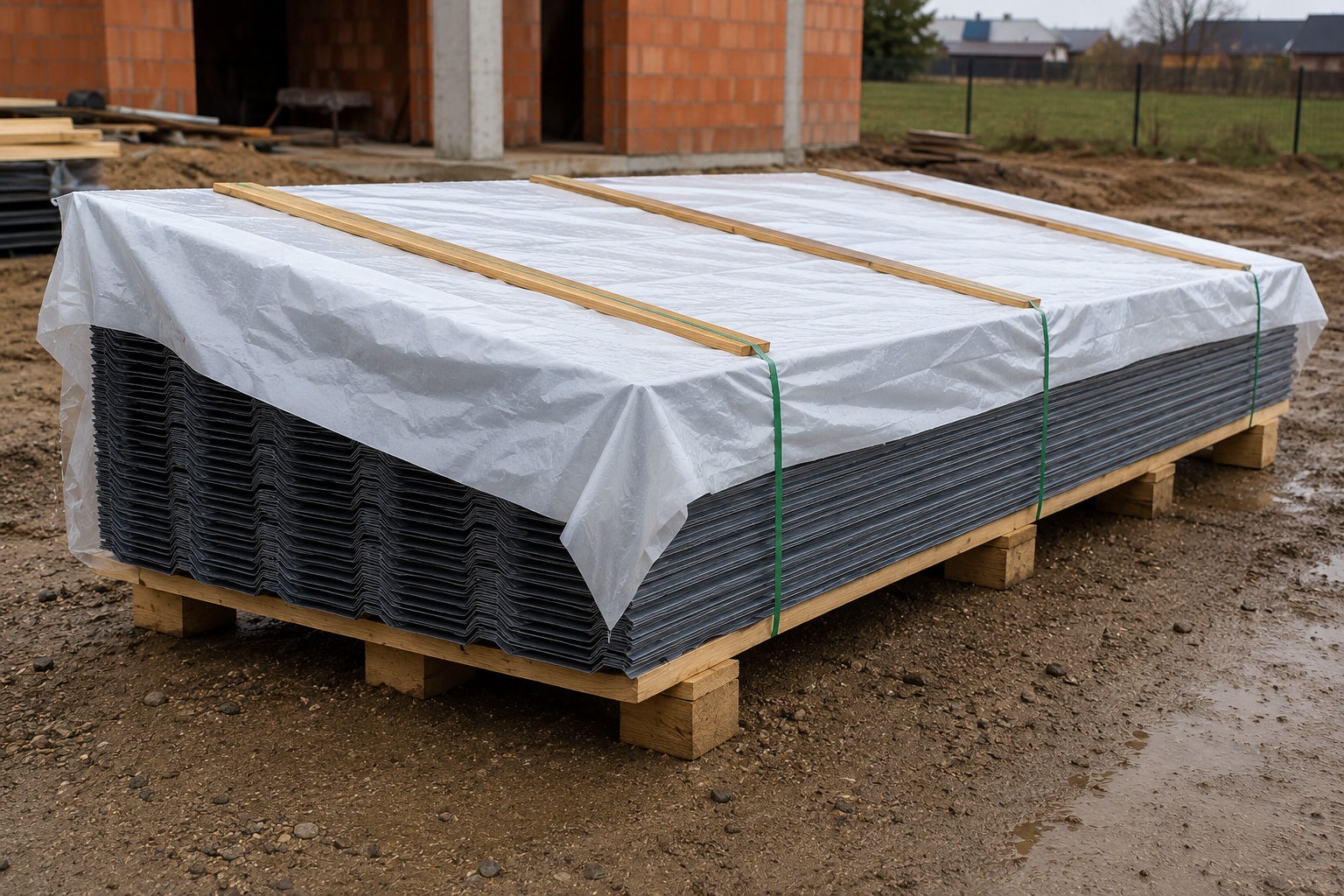
Never store the pack of panels directly on the ground, grass, or concrete. Moisture from the ground will quickly transfer to the sheet metal pack. Use wooden pallets, thick boards, or beams (for example, 10x10 cm) placed at equal distances of about one meter, to uniformly support the weight of the panels along their entire length.
Make sure the wood used as support is completely dry and has not been recently chemically treated with substances that could react with the metal. Keeping a distance of at least 20 centimeters from the ground ensures adequate ventilation under the pack.
2. Create an incline for water drainage
Even if you store the materials in a covered space, it is essential to give the sheet metal pack a slight incline. Place the wooden supports so that one end of the pack is higher than the other. This slope will allow any trace of condensation or accidental water to drain quickly off the surface of the panels, preventing moisture from stagnating between the layers.
3. Protect against bad weather, but allow ventilation
If you are forced to store the materials outdoors, cover them with a waterproof tarp, but do not wrap them airtight and do not place the tarp directly over the pack – use other pieces of wood in such a way that the tarp is not in direct contact with the panels. Air must be able to circulate freely through the pack to dry any condensation formed due to temperature differences between day and night.
Do not use thin, transparent plastic films, as these can create a greenhouse effect, amplifying condensation and excessively heating the panels. An opaque tarp, well-anchored so it won't be blown away by the wind, which leaves the ends of the pack open for ventilation and whose upper part does not come into contact with the metal panels, represents the ideal solution.
4. Correctly manage the protective film
Many metal elements come with a thin protective film applied from the factory to prevent scratches during transport. If storage is done indoors, in the shade, this film can be left on the panels.
However, if the materials are exposed to the sun, the film must be removed immediately. Under the action of UV rays and heat, the film's adhesive can melt and harden on the paint surface, becoming extremely difficult or even impossible to clean later, ruining the aesthetics of your roof.
5. Handle the panels with care
When moving individual panels, always wear protective gloves to avoid cuts from the sharp edges. Never drag one sheet of metal over another, as friction will scratch the paint layer. Lift each panel carefully, supporting it by the edges, and transport it vertically (on edge), not horizontally, to prevent bending in the middle.
How long can I keep the materials unopened?
If you have followed the rules above, the panels can be safely stored for a limited period, usually up to 30 days. However, if you know that the installation will be delayed for a longer period (for example, over the winter), it is recommended to unpack the pallet.
Separate the panels and place thin slats of dry wood between them to ensure perfect ventilation on both sides of each sheet. This procedure requires more space, but completely eliminates the risk of damage caused by trapped condensation.
What do you do if the panels got wet?
If you notice that water has penetrated into the sheet metal pack during an unexpected rain, act quickly. Do not leave the wet pack to dry on its own. Undo the ties, separate each individual panel, and wipe the surfaces with a soft, dry cloth. Allow the sheets to ventilate completely before re-stacking them, making sure to add spacers between them.
Conclusion: Proper preparation ensures a trouble-free installation
A durable roof begins with the care given to the materials from the very first day they arrive on the construction site. By respecting these simple storage and handling rules, you ensure that your SMART system will maintain its impeccable appearance and all technical properties over the long term.
A few minutes invested in preparing the storage space can prevent costly damage and unpleasant installation delays. If you have additional questions about preparing your project, the SMART team is ready to offer you the best solutions for a resistant and durable roof.